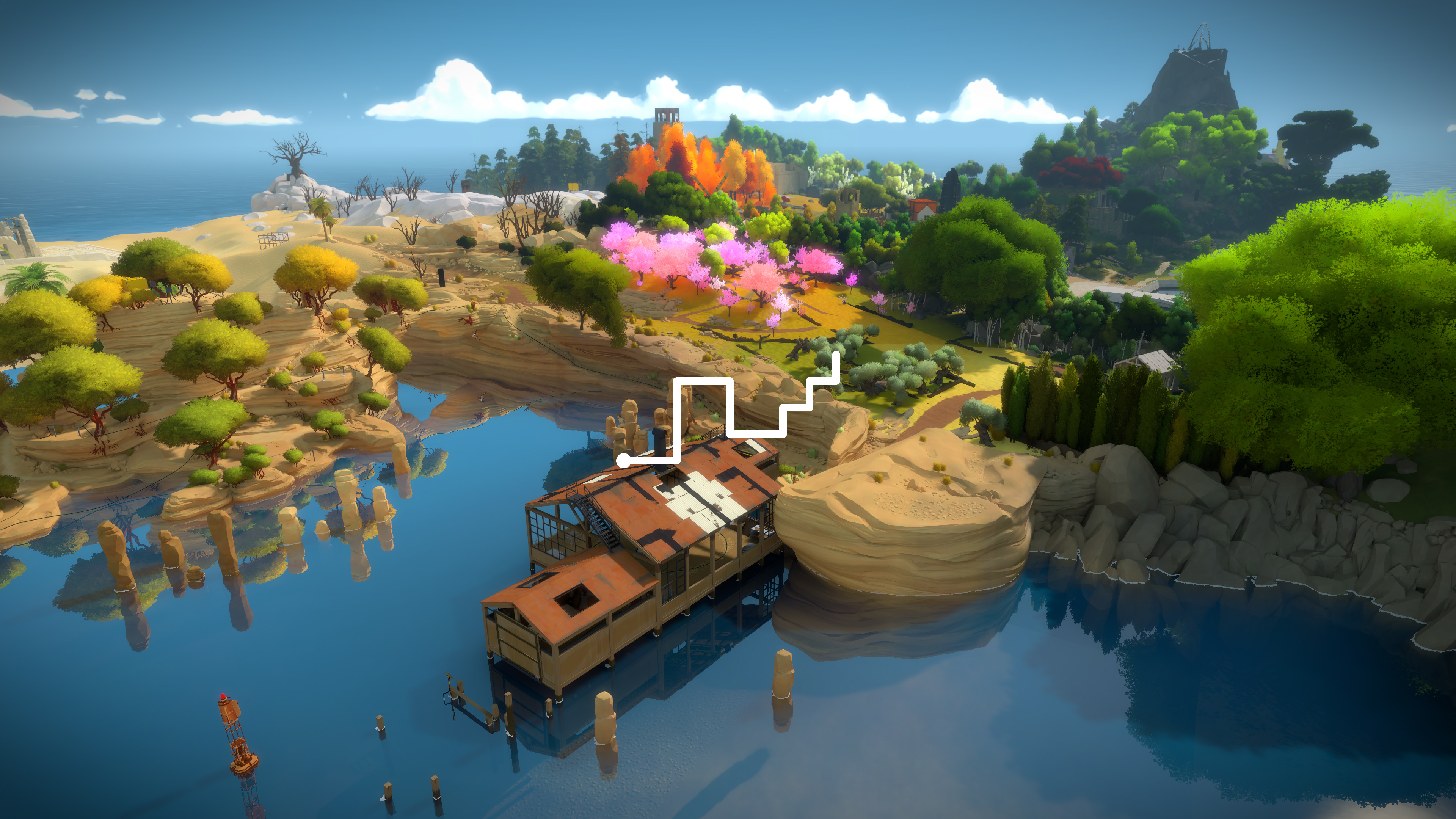
Following the critical and commercial success of the video game Braid — which gave the modern indie game scene a serious shot in the arm in 2008 — Jonathan Blow, its brilliant creator, set out with his Thekla Inc. teams on an even more ambitious project; a project that would earn a place in my video-gaming Pantheon and deserve that I discuss the qualities of its design, right here.
It would take 8 years for The Witness to follow in its big brother's footsteps, this time as a first-person puzzle game, a genre introduced and popularized by Myst, Riven and later Portal, but taken to a radical extreme here: no prologue, you start out on an island in an open world, with the tacit goal of exploring these remarkably calm and rather pleasant surroundings, dominated by a mountain that looks like a final boss.
The Island
Here and there, strange panels are scattered about, almost like beacons meant to steer your exploration.
On these panels: puzzles of a particular kind, which consist in drawing a line to connect a starting point to an exit, on a fixed grid, while following rules implied by ornamental symbols.
Typically, one group of puzzles introduces a new logic, with rising difficulty; once solved, it activates a new set of panels further along, which lets you put your newly acquired logic to the test, and then you carry on toward a dock on a glassy-calm sea, where — spared the rust of the sea spray — other panels await, and so on and so forth...


Each new case helps refine our understanding of this signage and builds up reflexes for certain familiar patterns.
You learn to spot layouts that require grouping symbols together, or keeping others apart; you recognize situations that invite you to mentally work out a path backwards, starting from the exit...
Since the game is non-linear, you sometimes need to know when to walk away from incomprehensible puzzles and venture somewhere else, where more basic versions will train you in the use of new signs.

This gameplay loop deftly weaves together two paths: one of your understanding, the other of your discovery of the island — which naturally leads you toward the mountain top — both contributing to lifting the veil on the mysteries of this place.
Well-Kept Secrets
I have a particular admiration for the bare beauty of games with diegetic UI, like Dead Space, or no HUD at all, like Mirror's Edge, Stray or Inside, and The Witness joins that closed circle of rare elegance in the service of immersion.
Add to that an intuitive — even rudimentary — gameplay, a true masterclass in instant, intuitive onboarding: the game only holds your hand for the first 10 seconds. (isn't that right, Capcom)


That's it.
The visual style falls into stylized realism: low-poly, clean and poetic; the environments are varied and beautifully crafted, all wrapped in a minimalist, polished soundscape.


This deliberate choice aims for a meditative state shielded from any distraction: every object is thoughtfully placed, to guide your progress or serve the diegesis; the level design and puzzle mechanics contribute masterfully to the themes explored.
No music, just the sound of your footsteps and the surrounding nature; zero bugs, not a single stray polygon; an in-house engine designed to eliminate loading times. The technical execution is flawless, and nothing must disturb your ascension... I mean, your attention, so that you may slowly but surely enter a state of maximum concentration.
For in this place, your logic and your wits are put through the wringer and your successes come with no fanfare: don't expect a trumpet blast or a cutscene for pulling 3 levers in the right order or guessing the last digit of a safe's combination.
The deal is clear: here you feast on puzzles, ingeniously spun out half a thousand times without a single repeat, with calculated variations, each one bringing one more level of understanding, again and again, hooked on the clack of a conquered panel triggering the next.
You understand a little more, you take a few more steps... But toward what, and for what purpose?

The main obstacle to progress: that feeling of aimless wandering which, when it confronts us with our unmet need for recognition, torn by our impatience, comes before discouragement.
Paradoxically, these delicious moments of idleness are a lifeline — so rare in this age of instant gratification and perpetual distraction, so essential to letting our imagination take flight and grasp complex situations.
Still, to make sure these spells of idleness are only temporary, you'll want to arm yourself with a notebook or some loose sheets of paper, a few pencils, an eraser. (And of course your favorite beverage)
Seriously, don't skimp on this bare-minimum kit: you'll be glad to pick up the thread of your reasoning after a break, whether it lasts a few hours, a few days... Or a few months in my case, discouraged by a game design choice — a bold one, admittedly, but clearly disorienting — from our dear Mr. Blow.
Trick
Let me say it again: scribble in your notebook, future-you will thank you.
That said, your smartphone proves a precious ally: take a photo of an unsolved puzzle, work on it in your phone's photo-editing app, and use the drawing tool to test out paths.
Let me bear witness
You can probably tell by now: if I'm devoting an article to it, it's not for its hybrid proposition of cereal-box puzzles crossed with a walking sim, but because The Witness offers something unique and magnificent.
SEMIOTICS
The game's greatest strength lies in its masterful learning process — so masterful that it dares to leave you entirely free to explore the island's different areas, with no invisible walls, no intrusive pop-ups, no tutorial, each area introducing new puzzle mechanics.

Faced with a new type of puzzle, you fumble, you babble; the first specimens are forgiving and several paths will work, you brute-force them, you make rough guesses about their nature.
And then sometimes comes a very similar puzzle — except that it introduces an exception, chipping away at our certainties about a symbol we thought we had mastered; and that forces us to re-examine earlier specimens more closely.
The old adage that "we learn from our mistakes" takes on its full meaning here.
It's hard going; you stumble, you sigh.
But each time, you make progress — it's exhilarating.
And you jot down a few notes in your precious notebook, like a physicist working out a theoretical model on a big blackboard:
From the results of our experiments, we determine the laws that govern them; we decipher the grammar of the symbols; we crack the language of the island's builders.
THE AWAKENING
In keeping with Braid, Jonathan Blow's obsession with the themes of perception, illusions and perspective shines through.


This manifests in the abundance of natural and artificial trompe-l'œil scattered across the island, which, beyond playing deftly with that fascinating phenomenon known as pareidolia, eventually plant the idea that certain devious puzzles might likewise be waiting to be approached from different angles to reveal their solution.
...Or their solutions?
Doubt creeps in, and you start considering revisiting places you've already been, armed with fresh eyes.
A question for you: can you repeat an experience exactly and perceive things differently?
And from this ardently pursued quest, there eventually emerges an alteration of perception known as apophenia.
This phenomenon of magical thinking sits at the heart of several puzzle mechanics and is the starting point of a major twist, tied to the central implicit theme, which I shall dutifully refrain from elaborating on, to spoil nothing.
For that is where the genius of this masterpiece lies: it holds in store for the sharp and sincere mind a shock, a vertigo, a revelation — a genuine epiphany, in the rational sense of the word — provided you have been sufficiently tested to reach the right point of view.
To go further
Video in English:
- The Witness Documentary, by Noclip, featuring an interview with Jonathan Blow.
Online puzzles:
Spoilers
This section contains links to spoiler-heavy content.
Video in French:
Video in English:
- The Witness - A Great Game That You Shouldn't Play, by Joseph Anderson
- The Unbearable Now: An Interpretation of The Witness, by Electron Dance
Classe, non ?
Répondre
Je ne te le fais pas dire !
D'autant que c'était cousu de fils blancs; cela demeure néanmoins une bonne surprise :)
Répondre
Oui, en effet
Répondre
Test 12345
Répondre